# I made two anime shorts from a command line. The second one cost $5.
> Higgsfield CLI, Seedance 2.0 Mini and FLUX.2: every credit, every failed shot, and the prompt that gets four shots out of one 15-second clip.
Published 2026-11-26 · https://smarterthanus.ai/anime-shorts-from-command-line/
## TL;DR
- Two 33–45 second anime reels, made from a terminal: Claude Code drove the Higgsfield CLI and I only approved frames.
- Film one cost **$11.95**; film two cost **about $5** for a longer film, with sound from the video model and no retakes.
- What halved the price: start frames from the FLUX API ($0.83 for the whole film) and three 15-second Seedance clips with the cuts written into the prompt.
- Higgsfield adds almost nothing over buying the models directly (under $1 per film), and moderation depends on the model, not the platform.
I run a small T-shirt shop with dark humour about AI, and in November I gave it a reel format: short, grim anime with Japanese dialogue and English subtitles. I made two of them without opening a single web panel. Claude Code drove the Higgsfield command-line tool, and I only looked at frames and said yes or no.
The first film cost **$11.95** in credits for 33 seconds. The second one cost **about $5** for 45 seconds, with sound that the video model generated itself and not a single retake. Below is every number, and the two changes that cut the price in half.
「圏内」 / I'M IN, 45 seconds. Dialogue, the scream, the train and the music all come from the video model; only the subtitles were added in editing.
## How the work looked from a terminal
Higgsfield is an aggregator: one account and one credit balance for many image, video and voice models. It also ships a CLI. I typed two commands myself:
```
npm i -g @higgsfield/cli
higgsfield auth login
```
There is no API key. You log in through the browser and generation spends the credits of your plan. My first mistake was trivial: I bought the plan on my private address, and the CLI logged into my company account, which was on the free tier.
From there Claude wrote the prompts, ran the jobs, downloaded results and built contact sheets for me to judge. A single call looked like this:
```
higgsfield generate create wan3_0 \
--prompt "..." \
--start-image r07e1.png --end-image r09g.png \
--duration 4 --aspect_ratio 9:16 \
--wait --json > c08w.json
```
Why a CLI when there is a web panel? Because the agent then owns the files. Every frame sits next to its prompt and a JSON file with its parameters, so a fix starts from what was really sent. `generate cost` quotes the price before a run and `account transactions` returns the credit history, which is where every number in this article comes from.
The CLI has rough edges. With more than about 4 images or 2 videos running at once it returned `not_enough_credits` although there were enough. Seedance 2.5, which is listed on the Starter plan, failed through the CLI with `"Pro" or "Ultimate" plan required`. And the cheap video models have a 4-second minimum, even when you need a second and a half.
One limit is almost funny: Claude can't hear. It judged frames on its own, but for voices it built a file of numbered samples with a second of silence between them. I listened and replied "1 and 11".
## Film one: $11.95 for 33 seconds
The first film has 10 shots in vertical 720×1280. Active work, including publishing, took under 3.5 hours across one afternoon and evening. I was on the Starter plan: $19 a month for 270 credits, about 7 cents a credit. The table includes every failed attempt.
| What | How much | Credits | USD |
|---|---|---|---|
| Images: Nano Banana Pro | 53 images | 106 | 7.46 |
| Video: Seedance 2.0 Mini | 12 clips × 4 s | 48 | 3.38 |
| Video: Wan 3.0 | 1 clip × 4 s | 7 | 0.49 |
| Video: Seedance 2.0 Fast | 1 rejected, refunded | 0 | 0 |
| Sound effects | 8 | 7.75 | 0.55 |
| Voices | 8 tries, 1 refunded | 1 | 0.07 |
| **Total** | | **169.75** | **11.95** |
Images took 62% of the credits, video 32%. Only about ten of the 53 images made it into the film; the rest were character sheets, room layouts and rejected versions. That looks wasteful until you compare the price of a mistake: fixing a frame costs 2 credits and you see the result at once, while fixing a clip costs at least 4 and you wait for it.
The original plan was to render final shots in Seedance 2.5. At 720p that is 28 credits per 4 seconds, so 10 shots would have eaten 280 credits, more than the whole plan. Seedance 2.0 Mini delivered 9 of the 10 shots in the film for 48 credits, retakes included.
To be fair about the money: I paid $19, not $12. If you make one film and cancel, the real cost is a month of the plan.
## Film two: about $5 for 45 seconds
The second episode is 45 seconds. A girl on a night train in Tokyo looks up from her phone and sees that everyone around her is wired by cables to one machine. The machine notices that someone is awake. Then she wakes up in the same seat, and by the door two goths joke: "I know kung fu." "Show me." I wrote that exchange myself; Matrix fans will know where it comes from.
I changed two things after the first film, and both helped with cost and quality.
### 1. Images through the FLUX API instead of Higgsfield credits
In the first film, images ate 62% of the budget. This time the start frames and references came straight from the Black Forest Labs API (FLUX.2 Pro), at 4.5–6 BFL credits per 720×1280 frame. The whole film used 82.5 credits, which is **$0.83**. Higgsfield credits went only to video.
What worked best was editing an approved frame: faces and layout stay, one thing changes. Frames generated from scratch from a description alone drifted. Characters got softer faces, swapped sides, and once three people became two.
### 2. Three 15-second scenes instead of ten 4-second clips
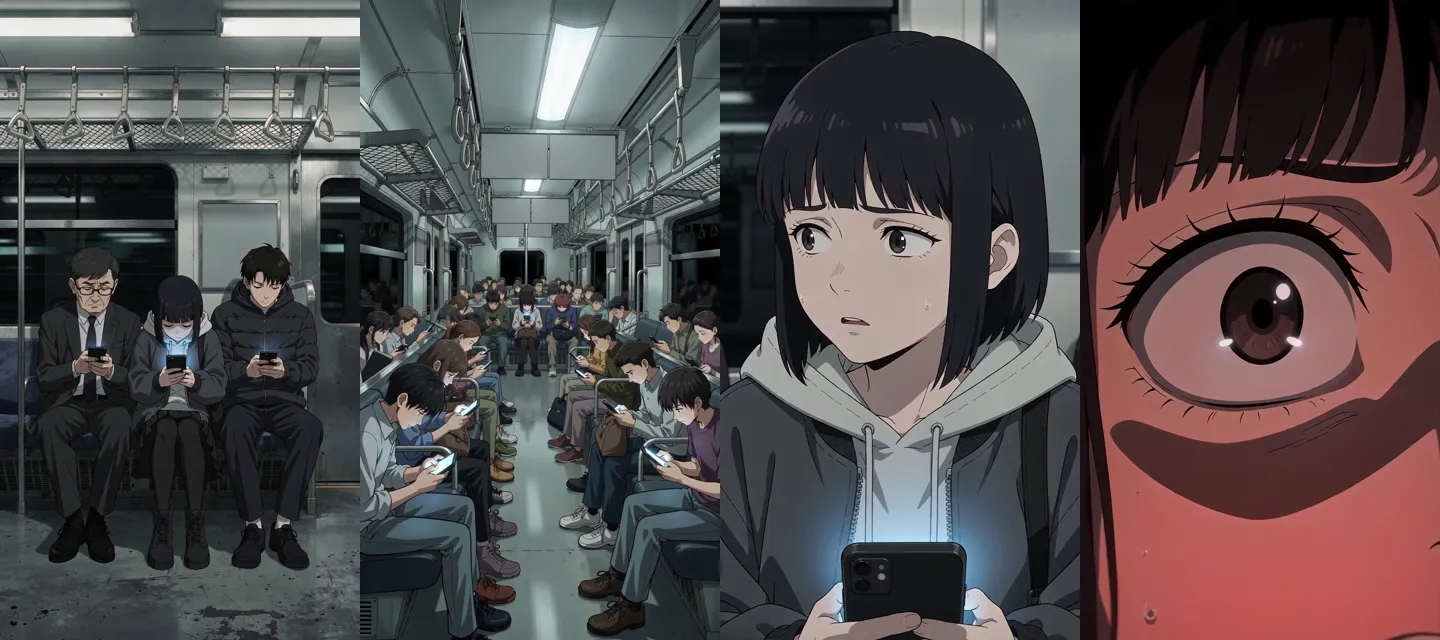
In the first film every shot was its own clip, and I added voices, effects and music in editing. This time Seedance 2.0 Mini got three prompts of 15 seconds each, with the cuts written into the text, and sound generation switched on, which costs nothing extra:
```
Shot 1 (0-4 s): the start frame, static camera. A young woman
with a chin-length black bob sits between a salaryman and a student...
Shot 2 (4-7 s): hard cut to a wide view down the whole car...
Shot 3 (7-11 s): hard cut to a close-up of the woman's face...
Shot 4 (11-15 s): hard cut to an extreme close-up of her eyes...
Sound: only sounds from inside the scene. A steady rumble
and rhythmic clatter of a subway train... No music at all.
```
One 15-second clip, four shots with hard cuts, all from a single prompt.
Three finished scenes came back, each with 3–4 shots and hard cuts, with sound: Japanese dialogue with lip movement, a scream, train noise, music. All three were usable on the first try. Nothing was dubbed afterwards, and the sound finally fits the picture because it was made together with it. For me that is the biggest jump in quality.
| What | How much | Cost | USD |
|---|---|---|---|
| Character sheets on Higgsfield (before the method change) | a few variants | 14 cr | 0.99 |
| Video: Seedance 2.0 Mini with sound | 3 clips × 15 s, zero retakes | 45 cr | 3.17 |
| Images: FLUX.2 Pro via API | start frames and references | 82.5 BFL cr | 0.83 |
| **Total** | | | **about 5** |
The second film is 12 seconds longer than the first and cost less than half. The Higgsfield plan still costs $19 a month; these amounts are the credits used.
## Higgsfield or straight from the model makers?
Higgsfield is a middleman, so the obvious question is how much it adds. Almost nothing, as of November 8–9, 2026 (some prices from third-party lists, so treat them as approximate):
| Model | Higgsfield (Starter) | Direct | My film 1: Higgsfield / direct |
|---|---|---|---|
| Nano Banana Pro, 2K | about $0.14 per image | Google: $0.134, Batch $0.067 | $7.46 / $7.10 (Batch $3.55) |
| Seedance 2.0 Mini, 720p | about $0.07/s | BytePlus about $0.08/s, fal about $0.155/s | $3.38 / $3.65–7.44 |
| Wan 3.0, 720p | about $0.12/s | $0.10–0.14/s depending on host | $0.49 / $0.40–0.56 |
| Voices and effects | $0.62 in total | ElevenLabs from $5/month | $0.62 / from $5 |
On one film the difference is under a dollar, and with a voice subscription counted it favours Higgsfield. Going direct starts to make sense in two cases: lots of non-urgent images (Gemini Batch is half price, but results can take up to 24 hours), or several films a week, when a few cents per shot add up. Content filters may also behave differently at each provider. I did not test that.
## Moderation: one model refused, another didn't
The key shot of the first film is violent. I assumed no model would render it, and I was wrong:
| Model | Result | Cost |
|---|---|---|
| Nano Banana Pro (frames) | Rendered frames with blood | 2 cr per image |
| Seedance 2.0 Mini | Didn't refuse, but couldn't do it: the anatomy fell apart | 4 cr |
| Seedance 2.0 Fast | Status `nsfw`, credits refunded | 0 |
| Wan 3.0 | Rendered it on the first try, from start and end frames | 7 cr |
Moderation lives in the model, not in the platform. On an aggregator, switching models is one parameter and a rejected job is free. This was one try per model, in animated fiction, in November 2026. Filters change; if your material might hit moderation, test one shot before you plan a whole film around a model.
## Limits worth knowing
- **Shot lengths in the prompt are a suggestion.** I asked for 4, 3, 4 and 4 seconds and got roughly 2, 2, 6 and 4. Fine for a reel, not for cutting to a beat.
- **Music doesn't carry across a cut between clips.** Each scene has its own sound, so one scene should be one place and one mood.
- **A frame from a different model stands out.** A wide shot built on a FLUX reference came out cleaner-drawn than the rest.
- **Filters can be odd.** Nano Banana Pro rejected an ordinary empty subway car as `nsfw`. The credits came back and FLUX made the image.
- **Claude still can't hear.** It assembled the film by checking the Japanese lines with transcription and a spectrogram, and placed subtitles where speech starts. I did the listening.
## What it means if you want to try
- **Use an agent with a CLI, not a web panel**, if you want to know what everything cost and repeat it. Every prompt and parameter is a file.
- **Generate scenes, not single shots.** One 15-second clip with cuts written into the prompt replaced four 4-second clips and all the sound work.
- **Make images where they are cheapest.** For me that was the FLUX API at under a dollar for the whole film.
- **Edit frames instead of regenerating them** to keep faces and rooms consistent.
If you want to repeat this, the tool I used is [Higgsfield](https://higgsfield.ai/?fpr=mateusz-b4ff07) (affiliate link). The Starter plan's 270 credits a month cover about four films made the second way.
## Sources
- [Higgsfield CLI on npm (@higgsfield/cli)](https://www.npmjs.com/package/@higgsfield/cli)
- [Black Forest Labs API pricing (FLUX.2)](https://bfl.ai/pricing)
- [Gemini API pricing (Nano Banana Pro / Gemini 3 Pro Image)](https://ai.google.dev/gemini-api/docs/pricing)
- [The first film on Instagram (@aidoomsdaywear)](https://www.instagram.com/reel/DfdaOYKsRcC/)
- [The second film on Instagram (@aidoomsdaywear)](https://www.instagram.com/reel/DgKhh5cKVP-/)
- [Original write-up in Polish (flowsystems.pl)](https://flowsystems.pl/blog/higgsfield-film-anime/)